 macOS App
A meeting assistant for Apple silicon Macs
Every word of the meeting, written down as it's said. Nothing leaves your Mac.
Otonota transcribes and summarizes while you're still talking. By default, audio and text stay on the machine — no cloud, no account, no upload. It's a tool for people who would rather listen than take notes.
Get it on the Mac App StoreFree · macOS 26 or later · Apple silicon
What's said becomes text, and the text becomes a summary — or two with Pro, each in its own mode and language.
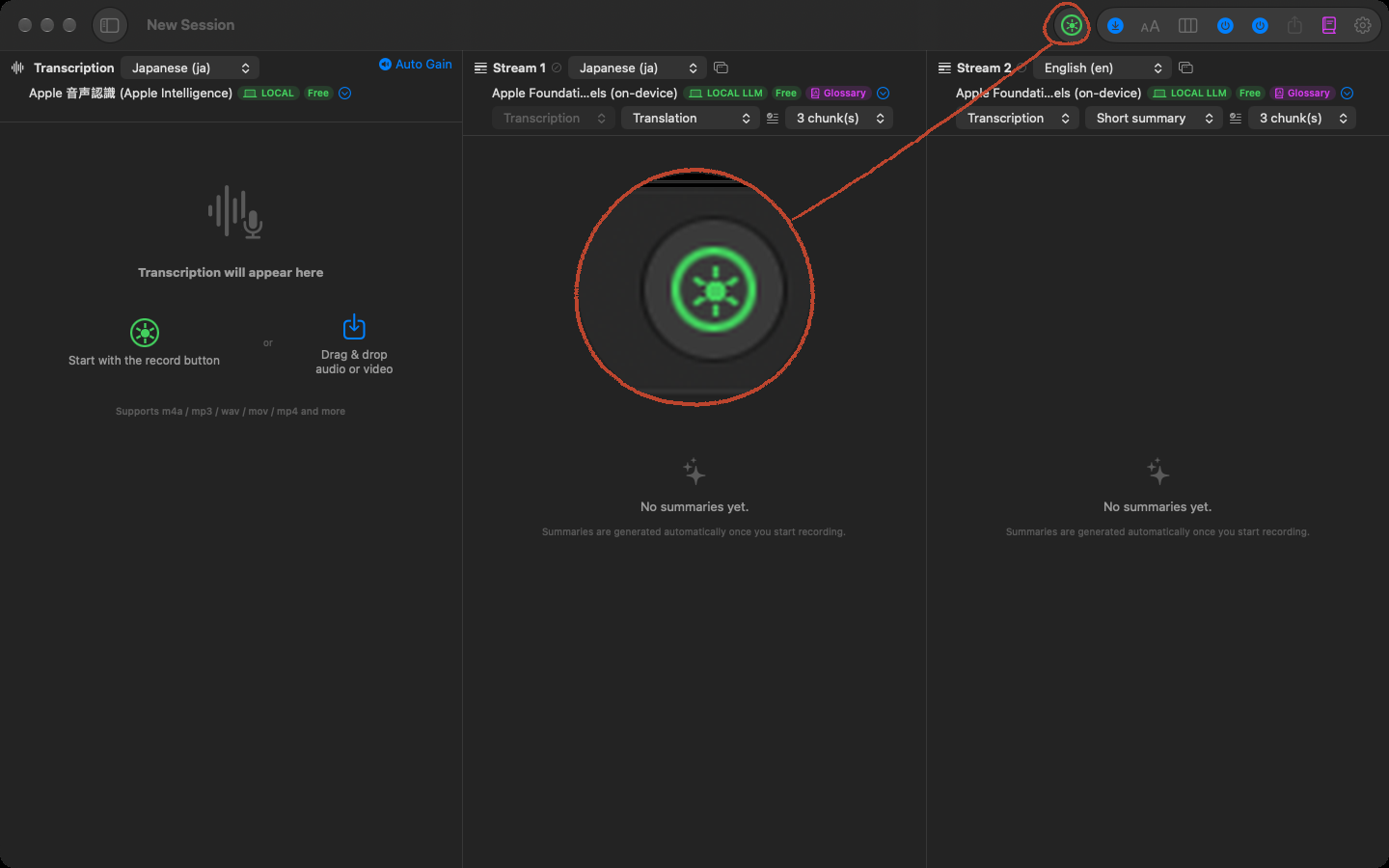
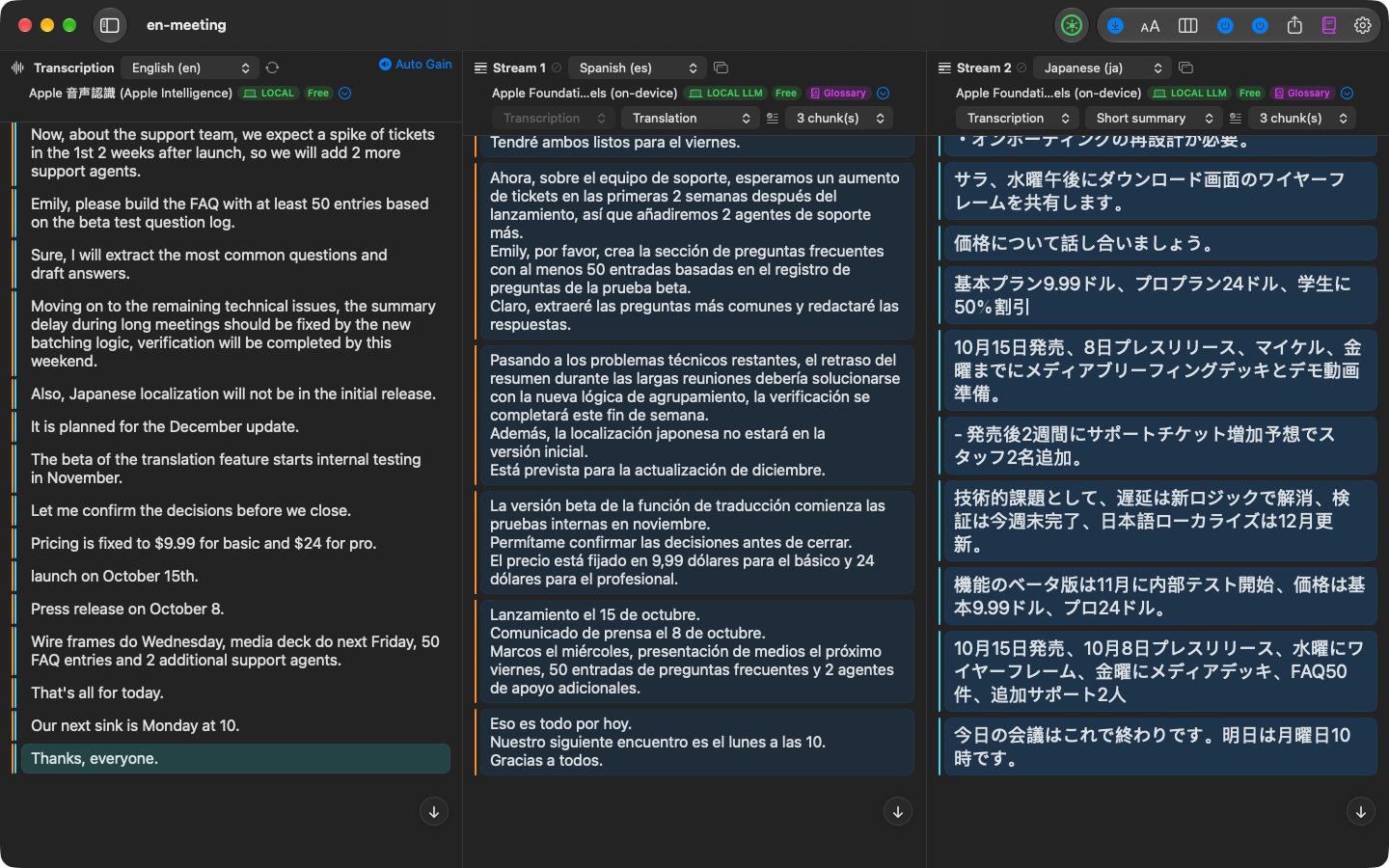
The window has up to three columns. On the left, completed transcript entries appear with timestamps. Text still being transcribed appears in a lighter bubble. The middle and right columns show two summary streams that update every few lines, each in your chosen mode: a short summary, a conversational summary, keywords, or a translation — and each in its own output language. Follow a short English summary in one while a Japanese translation runs in the other.
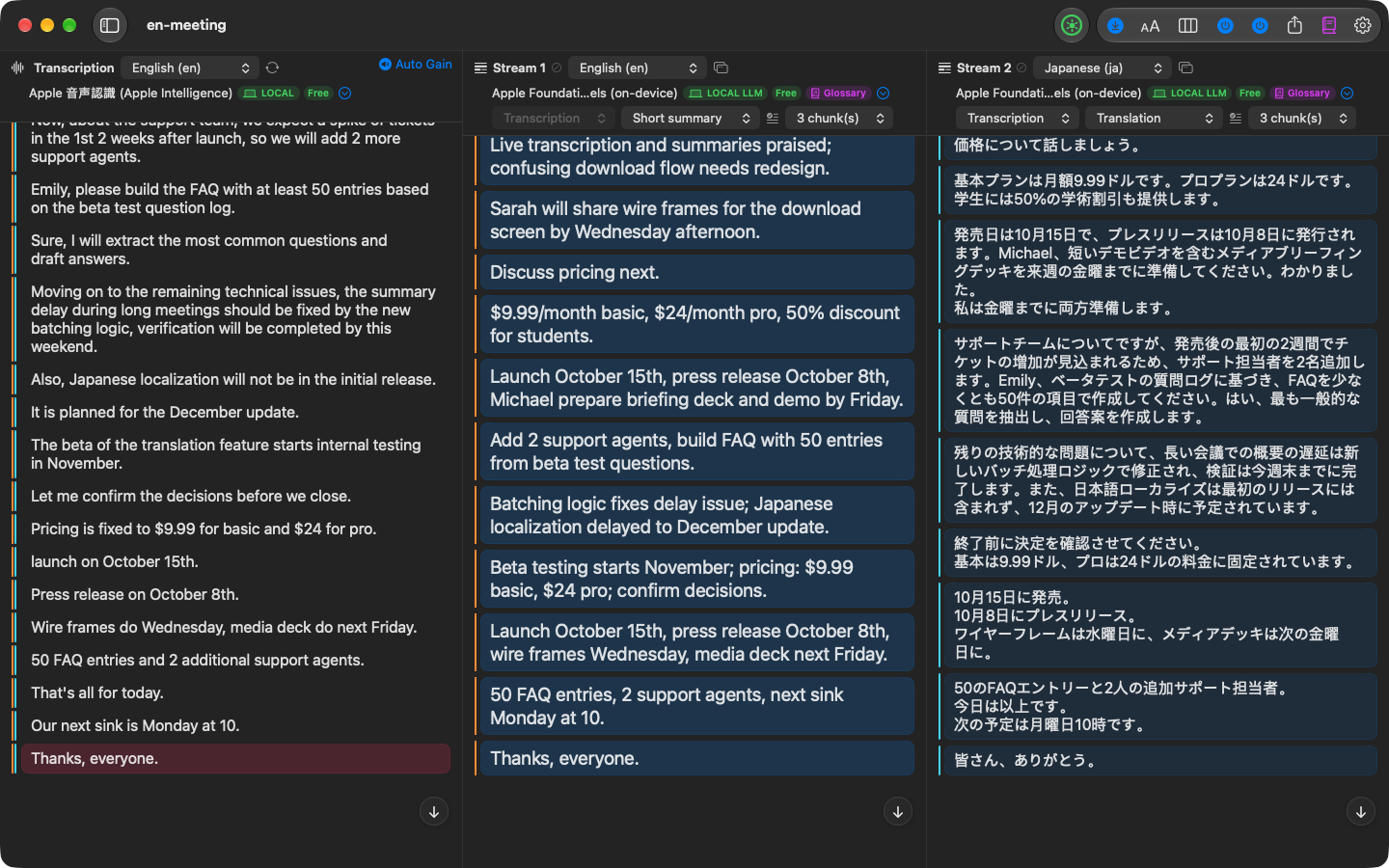
You can record from your microphone or capture system audio, so you can also transcribe what other participants say in a Zoom or Google Meet call.
By default, transcription and summarization don't use the network.
Transcription and summarization run on Apple's speech recognition and Apple Intelligence, or on WhisperKit and MLX models running locally on the Mac. That makes it usable where cloud transcription isn't:confidential negotiations, interviews, clinical or legal consultations. It works on a plane. The planned Pro upgrade will let you enable cloud language models with your own API key — never by default.
Otonota looks at the chip and memory in your Mac and picks a sensible pair of engines to start with. An 8 GB MacBook Air runs on Apple's built-in engines; 16 GB and up unlocks larger on-device models. You can change engines at any time.
Follow a meeting held in Japanese through an English summary, or keep English notes from a lecture given in German. The interface, summaries, and translations come in these 22 languages. You can add product names, people's names, and internal jargon to a glossary to improve both the transcript and the summary.
- Japanese
- English
- Chinese (Simplified)
- Korean
- Spanish
- French
- German
- Italian
- Portuguese
- Russian
- Arabic
- Hindi
- Vietnamese
- Thai
- Dutch
- Swedish
- Norwegian
- Danish
- Finnish
- Polish
- Turkish
- Indonesian
A red dot marks the 10 languages the Mac's built-in engines can also transcribe. The other languages are transcribed by WhisperKit, which is included in the free version. The interface, summaries, and translations cover all 22.
Import an existing audio or video file for the same transcription and summarization process (Pro). When you're done, export the audio and, with Pro, JSON, CSV, and SRT with elapsed times from the start of the recording — plain files you can keep, not a format you're locked into. And if the app crashes mid-meeting, the recording and transcript survive: they're saved to disk every few seconds, and Otonota offers to pick up where it left off.
Record audio, transcribe and summarize it with the Mac's built-in engines, copy the text, and export your audio — all free, with no time limit.
| Feature | Free | Pro planned paid upgrade |
|---|---|---|
| Recording and transcription | ||
| Live recording (mic or system audio) | ○ | ○ |
| Transcription with the Mac's built-in engines (Apple Speech / Apple Intelligence). 10 languages: English, Japanese, Chinese, Korean, German, French, Spanish, Italian, Portuguese, Russian | ○ | ○ |
| Transcription with WhisperKit large-v3 (22 languages) | ○ | ○ |
| Transcription with the larger WhisperKit models (large-v3-turbo and others) | — | ○ |
| Cloud speech recognition with your own API key (usage is billed to your own account with that provider) | — | ○ |
| Summaries and translation | ||
| Summaries with the Mac's built-in Apple Intelligence, in four modes (short summary, conversational summary, keywords, translation) | ○ | ○ |
| Summaries with MLX Qwen3.5 2B (22 languages)If Apple Intelligence is unavailable on your Mac, Otonota offers to download this model and use it for summaries | ○ | ○ |
| Summaries with the larger MLX models (Qwen3.5 4B and others) | — | ○ |
| Cloud language models with your own API key (OpenAI, Google; usage is billed to your own account with that provider) | — | ○ |
| Second stream (a summary and a translation running side by side) | — | ○ |
| Glossary and context hints | ○ | ○ |
| Show Stream 1 / Stream 2 in a separate window (each on its own, or both together) | — | ○ |
| Export and import | ||
| Copy transcripts and summaries as text | ○ | ○ |
| Export your recorded audio files and the transcript and summary text (without timestamps) | ○ | ○ |
| Export with elapsed times from the start of the recording (JSON, CSV, SRT subtitles) | — | ○ |
| Import and re-transcribe audio and video files | — | ○ |
| Overall | ||
| Available in 22 languages | ○ | ○ |
| Output languages for summaries and translations | 22 (15 with Apple Intelligence, 22 with the MLX model) | 22 |
| Time or usage limits | none | none |
| Price | free | one-time purchase (planned) |
The Mac's built-in engines, plus one WhisperKit model and one MLX model, are available for free. The other engines require Pro. You can export your recording and the plain text of the transcript and summaries for free. Exporting data with elapsed times requires Pro. If you use cloud speech recognition or language models, the providers' API usage fees are not included in Otonota's price and are billed directly to your own account. Pro is a planned paid upgrade, sold as a one-time purchase — not a subscription. Price and timing will be announced once they're set.
- Does any audio get uploaded?
- Not by default. The planned Pro upgrade will let you enable cloud speech recognition with your own API key, which sends audio to the provider. If you enable a cloud language model instead, only text is sent — never audio. There is one exception: if you choose Apple Speech for transcription and on-device recognition for that language isn't available on your Mac, macOS may recognize the audio on Apple's servers as part of the operating system. If that matters to you, choose Apple Intelligence transcription or WhisperKit.
- Will it capture the other side of a Zoom or Meet call?
- Yes. Choose system audio to capture what other participants say, or your microphone to record your own voice.
- Which Macs?
- Apple silicon Macs on macOS 26 or later. 8 GB of memory is enough for the built-in engines. On first launch Otonota looks at your chip and memory and picks engines and settings that won't strain the machine; you can then adjust the model and the summary window (how many segments go into one summary) at the top of each pane to match your Mac. Pro's local models only appear in the list if they fit in memory, but fitting is not the same as running smoothly: larger models take longer to summarize. Pick one that suits your Mac.
- Which languages?
- The interface, summaries, and translations come in 22 languages. Apple Intelligence writes summaries in 15 of them; the small MLX model included in the free version covers all 22. The built-in engines transcribe 10 languages (English, Japanese, Chinese, Korean, German, French, Spanish, Italian, Portuguese, Russian); WhisperKit large-v3, included in the free version, covers all 22. Pro adds the larger WhisperKit models.
- Is there a time limit on the free version?
- No. The free version has no time or usage limits.
- Can I get my recordings out of the free version?
- Yes. Exporting your recorded audio files and the plain text of the transcript and summaries (no timestamps) is free. Exporting JSON / CSV / SRT with elapsed times from the start of the recording requires Pro.
- Windows?
- No plans. Otonota is built around on-device AI on Apple silicon.
- Where are the settings and engine choices explained?
- In Help, in the order the app presents them.
Otonota is free on the Mac App Store. There's no account to create — install it, press record, and you're using it.
Get it on the Mac App StoreSend feedback
macOS 26 or later · Apple silicon (M1 and up)